Know someone who'd love Litopia? Share the link below.









Out and About when Autumn Leaves had Fallen
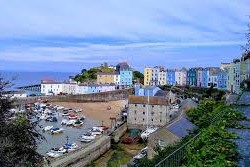
Late November 2025… Mrs Treaclechops and I enjoyed a 5-day break in Pembrokeshire. We know the area fairly well because our son lived in the vicinity for 20 years, and we visited him once a month over that period. Our jaunt included day trips to Tenby, Saundersfoot, Cardigan and Laugharne. It’s a picturesque part of Wales with a glorious coastline, and vibrant small towns and villages nestled in verdant countryside.
There are lots of quaint independent shops, and we enjoyed a good browse in each location. In Cardigan, we found a small vegan coffee shop down an alley called The Black Lion Mews. Unfortunately, they didn’t serve toasted teacakes but we had a large slice of elderflower cake each. Very unusual and very nice. The place seemed to be a meeting hub for eccentric hippy types. No problem… the world would be a far better place with a few more eccentric hippies and a few less billionaires.
Tenby has a fantastic mediaeval wall that encircles much of the old town centre. It dates back to the 13th century, and was built by Flemish migrants who were allowed to settle here by the Norman conquerors. The wall was to defend the settlers against the supplanted indigenous Welsh, who were, understandably, in revolt. It’s considered to be the best-preserved mediaeval wall in the UK.
There are tunnels beneath Tenby town centre which were constructed by merchants in the 15th century to store goods, and allow easy passage to ships in the harbour. In 1471, a young man named Henry Tudor used the tunnels to escape from Yorkist soldiers who were hunting him for supporting the House of Lancaster. He made it to a waiting French ship, and was given sanctuary in France for 14 years, before returning to England in 1485 to be crowned Henry VII, the first monarch of the Tudor dynasty… and we all know what happened after that.
Laugharne, of course, is famous for its connection to the poet, Dylan Thomas. He lived in The Boat House (now a museum) for a number of years, and it’s the place where he wrote many of his famous works, including ‘Do Not Go Gentle’, and ‘Under Milk Wood’. US presidents Clinton and Carter visited the museum at different times. Democrats visiting a poet’s house of inspiration… I wonder if that’s significant.
Pembrokeshire has an interesting coal mining history spanning over 500 years. High quality anthracite was mined in the mid 19th century, but only in small quantities, and in a geologically difficult area. Most coal mining in Wales was based further east where the geology was much easier to work, attracted higher investment, and offered better wages. Pembrokeshire miners were among the lowest paid in the UK, and most were too poverty-stricken to move to more lucrative areas. Men worked at the coal face extracting the coal, small boys then hauled it on trolleys along narrow tunnels, while women worked on the surface winching and loading the extracted coal for shipment. Farmers would supplement their income by transporting it to local ports and quays for export.
Boys were mostly seven or eight years old, though if a boy was considered strong enough at age six, he would be required to work and contribute his pittance to the family income pot. Two boys to each trolley… one at the front and one at the back… crawling on hands and knees. When they got too big for the tunnels, they would move on to the coal face with the men. Everyone worked 14-hour shifts over six days, with lunch breaks consisting of bread and cheese. The life expectancy of a miner in 19th century Pembrokeshire was 40 years. If one of them reached the age of 45, they were considered very lucky. As someone once eloquently observed, ‘Land of hope and glory, my arse!’
The hotel where we stayed had an eccentric employee who had worked there for 52 years, fulfilling every position in that time. He’d only just returned to work after a minor heart attack, and advised us that he had no intention of retiring. His main role seemed to be to impart anecdotes each evening in the bar to guests about his working life, recommend local attractions to visit, and, of course, to encourage them to book the hotel for future visits.
He told us that his mother worked as a maid at Buckingham Palace in the 1940s, and was proud of the fact that she stayed at her post throughout the war. Then his voice faded to sadness as he related how she had to leave her employment when she became pregnant with him… ultimately an unmarried mother. On the final day of our stay, a mischievous young staff member confided to us about a rumour that the man’s father was a senior member of the royal family. He told us the name of the individual, but I don’t fully pass on unsubstantiated rumours… not even salacious ones!


Out and About when Autumn Leaves had Fallen
Love the history!
History is amazing.
There’s a novel begging to be written, although the royals might sue!
I’m too scared to write it.
Enjoyable and interesting read, Mick. And I’m with you 100% on your preferred ratio of hippies to billionaires. Needed more now than ever before.
Cheers, Jonny. Just having less billionaires may well be enough.
This makes me want to visit Pembrokeshire. The tourist board should have you writing for them.
The eccentric employee at the hotel actually inspired me to write about it all. Great fun this blogging lark.