Know someone who'd love Litopia? Share the link below.









Sentencing
I am obsessed with sentences. So obsessed am I, it’s taken over a month to write and edit all the sentences in this thousand-word post. Then I narrated it, listened back, and edited again before re-recording.
I love the anatomy of a sentence. I marvel at punctuation and form. I’m consumed by the shape and the sound, the colour and the rhythm, the way they spread out ahead, then spring up behind you. The long and the short of it. The rough and the smooth. I know those last two sentences weren’t complete sentences, but I like fragments too. In moderation. I like a sentence that sings. I enjoy a properly placed semi-colon. I recoil at a comma splice. I admire a lengthy sentence that doesn’t require any punctuation provided that it is a rarity.
(I once wrote a forty-six-word sentence without need of punctuation, but alas it’s too filthy to quote out of context. You’ll have to take my word for it or read Songs for Beginners.)
A sentence is not merely a string of words. It can be instructional. It can be beautiful. Some of the best sentences are functional and breath-taking. The recorded message at the end of the travelator up to the supermarket carpark always seemed to me like a metaphor for the last days of life: You are approaching the end of the walkway; please be prepared to step off.
I know I’m not the only one in love with sentences; it’s a passion of all writers. I’ve read whole books on the matter. I subscribe to a Substack devoted to the sentence. I contribute to Litopia’s own One Perfect Sentence competition every month without fail.
Without fail? That sentence, in relation to a competition where losing could be construed as failure, is ambiguous. And maybe that sentence too, whilst grammatically correct (I think), is almost as confusing as this one. Perhaps I need to re-read Steven Pinker’s The Sense of Style for some much-needed clarity.
Are you still with me?
What I mean to say is, I don’t fail to contribute, not that I don’t fail to win. I have won or been placed second or third quite often, but not without fail, and I expect I might’ve jinxed it now. And anyway, I didn’t enter the competition last month. I had an attack of sentence-fright, probably when I started writing this blog post. So, that sentence about never failing was a lie. But a sentence can be a lie as much as it is the truth. Or a fragment of the truth.
The thing about One Perfect Sentence is that we don’t get to see the relationship between that sentence and any others. In First You Write a Sentence, Joe Moran talks about how a sentence behaves in the company of other sentences. I like that. It makes me feel less alone in a universal sense as well as on the page. Some of my favourite sentences in One Perfect Sentence are ones where I can imagine the behaviour of the preceding and/or following sentences – not just what might happen from a plot point of view, but what that might sound like. For it’s the sound that matters to me. The cadence. The rhythm. The tone of voice. Meter is not just for poetry but can be used to great effect in prose.
I recently read a project in the Lab where a writer used several rather staid sentences of similar rhythm, one after another, conveying a car journey, lulling me into thinking the writing was erring on the dull. Then bam! A sudden short sentence to bring the journey to a stop. Remarkably effective, and I’d like to think it was intentional whether or not it was.
Yesterday, I started reading Ducks, Newburyport by Lucy Ellman. I remember reading her very short and very funny novels in the nineties and had to check whether (or not) this was the same author I thought I recalled from Sweet Desserts and Varying Degrees of Hopelessness. It is the same author, but her latest novel of 1,000+ pages, consisting of a single sentence, was rejected by her publisher, Bloomsbury. In a move both brave and smart, independent Galley Beggar Press picked it up, and the doorstopper went on to gain a Booker nomination and win the Goldsmith’s Prize. (Except that it would likely crash the server, it might’ve won the pinnacle of all literary awards, One Perfect Sentence.) I don’t know what my chances are of finishing Ducks, Newburyport, but it’s a surprisingly engrossing sentence fifty pages in.
Sentences also play a crucial role in my day-job as an Advanced Practitioner. Did you know that if someone is too breathless to talk in full sentences, they should be admitted to hospital immediately for emergency treatment? You don’t need to measure oxygen levels, forget percussing the chest and auscultating with a stethoscope, if someone can’t utter a sentence from beginning to end without gasping for breath, they’ve won a trip in a vehicle with flashing blue lights. Of course, I mean an ordinary sentence such as, “I don’t feel very well,” or “It hurts when I cough.” We don’t need anything like Ducks or Ulysses.
So, if you ever come across someone too breathless to spare a full sentence, do them a favour and call an ambulance. Sentence awareness saves lives.
And what is the point in all these sentences that I’ve thrown down here? They relate to one another somehow, even though it might seem only my random stream-of-sentence-consciousness. You’ll never know the hours I’ve spent rearranging them, changing from left-branching to right-branching, re-ordering the clauses, choosing whether to say whether or not or not…
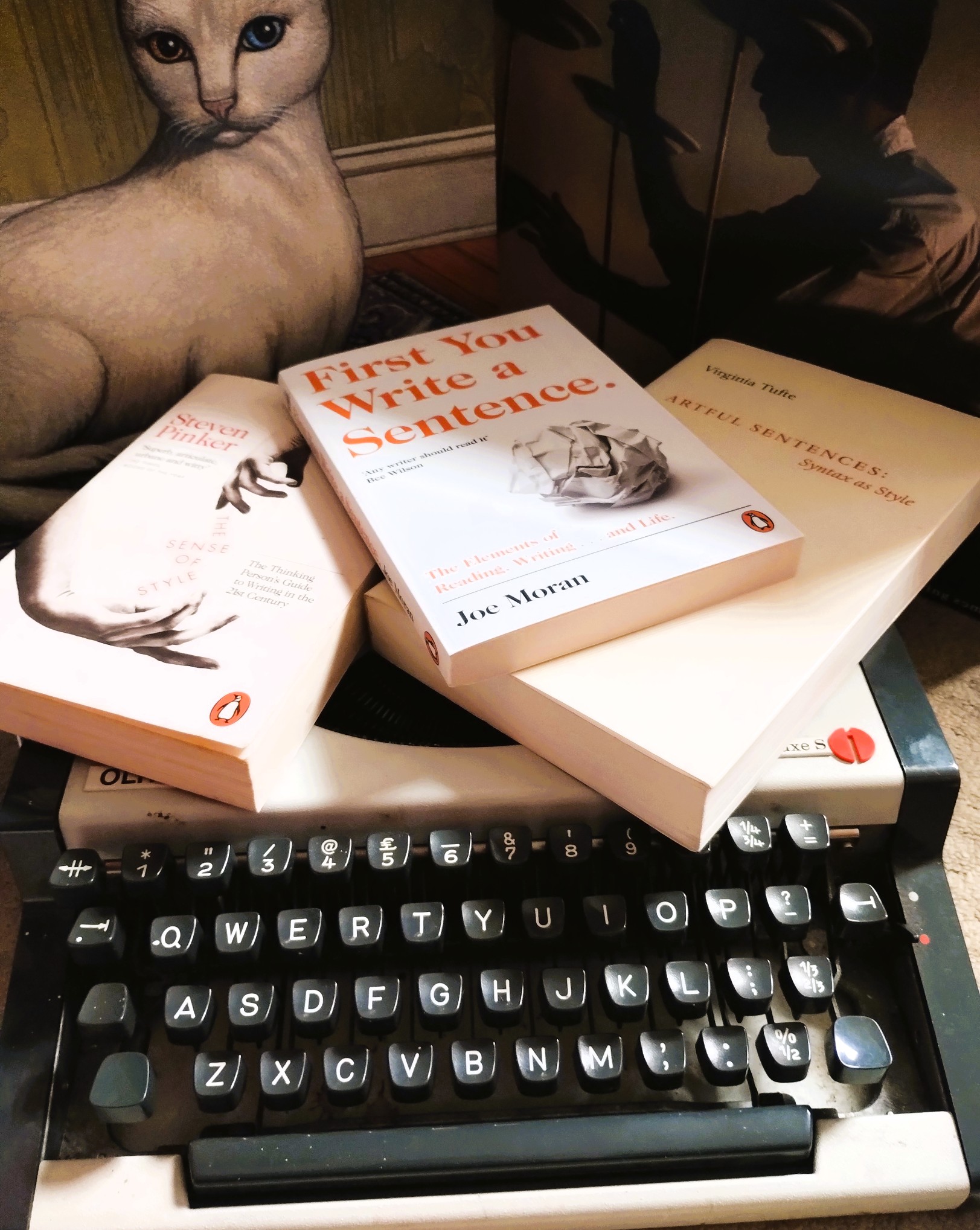
Recommended reading:
First You Write a Sentence Joe Moran, 2018, Penguin Books Ltd
The Sense of Style Steven Pinker, 2016, Penguin Books Ltd
Artful Sentences: Syntax as Style Virginia Tufte, 2006, Graphics Press LLC

Rachel McCarron's Newsletter
Subscribe to receive newsletters from Rachel McCarron directly in your inbox.
Rachel McCarron's Newsletter
Subscribe to receive newsletters from Rachel McCarron directly in your inbox.

 Songs for Beginners
Goodness, that’s a fine blog post. And narrated too! Love it 🙂