Know someone who'd love Litopia? Share the link below.









Hooks
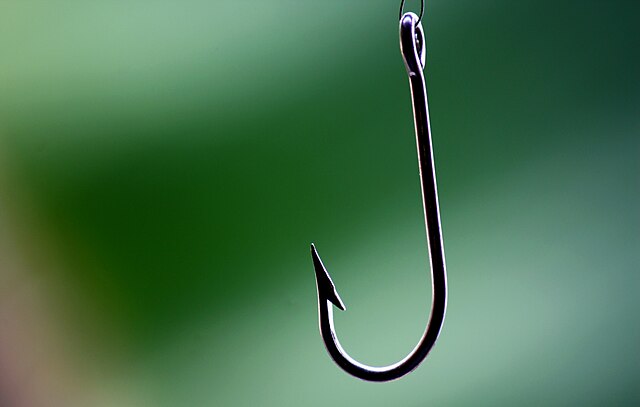
It’s the word I keep encountering again and again when listening to interviews with agents and publishers, especially when discussing commercial fiction, but what exactly is it?
A ‘hook’ is a sentence that sums up the premise of your book in one or two lines and makes your target audience want to find out more. It’s often called an ‘elevator pitch’ because it should be short enough to be delivered quickly if you find yourself between floors in an elevator with your dream agent!
It’s also the pitch an agent gives to entice a publisher, and the line that your publisher’s sales team will use to entice the book buyers for retailers. It’s the line booksellers will use to hand-sell your book to potential readers. Crucially, it also helps you, the author, to know if you have a strong idea on your hands (Jack Jordan, The Novelry website).
I listen to a lot of author interviews, and one of the first things they’re asked is ‘what’s your book about?’ Knowing your hook as an author helps you to distil the book into an engaging one-or-two-liner that you will be asked to repeat again and again (so you’d better learn it by heart!).
Short Examples
The serial killer isn’t on trial; he’s on the jury (Steve Cavanagh, Thirteen)
Lolita as told from the girl’s perspective (Kate Elizabeth Russell, My Dark Vanessa)
Tiffy and Leon share a bed. Tiffy and Leon have never met (Beth O’Leary, The Flatshare)
Kidnap a child to save your own (Adrian McKinty, The Chain)
Longer Examples
When a disillusioned ghostwriter who no longer believes in love returns to her family’s funeral home to bury her late father, she finds herself haunted by the ghost of her very hot and very recently deceased editor (Ashley Poston, The Dead Romantics)
An organised crime ring abducts the child of a leading heart surgeon and gives her an ultimatum: kill a patient on the operating table or never see her son again.
Which is stronger: a doctor’s oath? Or a mother’s vow to protect her child? (Jack Jordan, Do No Harm)
The latter says: When writing this hook, I included multiple key bits of information:
- The protagonist, her job, and the novel’s setting: leading heart surgeon
- The antagonist: organised crime ring
- The life-changing moment: given an ultimatum
- What’s at stake: never see her son again
- What must be done to resolve the issue: kill a patient on the operating table
- And finally, a question tied to the very premise of the novel – the moral dilemma – to leave the reader thinking: which is stronger: a doctor’s oath? Or a mother’s vow to protect her child?
In one line, this hook explains who the protagonist is, what they’re up against, and what they must do to survive, followed by a question that the reader is left to answer.
Experience
In the past, I haven’t thought about what the hook is before writing my novels. I suppose the closest I came is a ‘what if’ question (e.g. What if a grown woman had an imaginary friend? The Strange Imagination of Pippa Clayton). But the more I learn about commercial fiction, the more I realise how important having a hook is for a book’s potential success. I’ve even heard one author say they won’t write a novel if they can’t think of a clear one.
Final Thoughts
What’s the hook/elevator pitch of your novel?
Can you think of any other hooks from published novels?
Claire Gallagher's Newsletter
Subscribe to receive newsletters from Claire Gallagher directly in your inbox.
Claire Gallagher's Newsletter
Subscribe to receive newsletters from Claire Gallagher directly in your inbox.

Great post! I’ve always thought The Hunger Games has a superb hook. Apparently it appeared to her while channel surfing and seeing reality TV and war reporting.
That’s so interesting! I love how ideas can come from anywhere, at any time 🙂
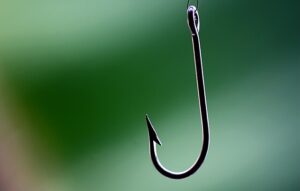
Interesting read. Fearsome hook image!
Excellent post 🙂 My fav short hook is ‘jaws in space’ (Alien). It’s more a tagline but it still hooks in three words.