Sunnyside: A Man Without a Country
By Brian Yarvin
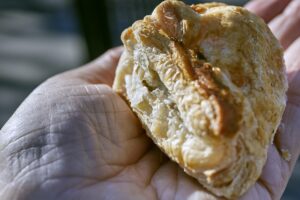
I had good reason to believe Poland was “my” country; cashiers in Polish grocery stores would speak to me in their native language and seem at least a bit surprised when I couldn’t answer. Family lore had it we were “Russian.” Dad had told me three of my grandparents came from there and the one outlier took the secret of her nation of origin to the grave.
Was any of this true? I had one bit of evidence; grandma made one item the other local grandmas didn’t; stuffed cookies. They were about the size of Chinese dumplings and made in a similar way with dough wrapped around a filling. This was it. There were no holidays celebrated, no language spoken in front of me besides English, and no dish a child could latch onto as a clue.
Whenever a food snob started asking how anybody could possibly buy those frozen peanut butter sandwiches, I always thought (but rarely said) “you never knew my grandma.” I’m certain she would have loved them. I’m just as sure there are people walking around right now who wax nostalgically for the long-gone afternoons when their grandmas thawed a frozen sandwich or two for them. Food memories are important, no matter what food it is.
Decades later and deep in the internet age, I sat down at a library computer terminal and dove into a famous genealogy website. Within minutes, I found all of my grandparents and a few moments later, a whole roster of legendary great aunts and uncles – most of whom I’d never met. Using their census records and immigration data, I found out all – except the grandma who made those frozen dinners – were from Romania, a country nobody ever mentioned. My dad and uncle were so deeply in love with Lenin and Stalin they put themselves under the protective cloak of Mother Russia and the hammer and sickle. Nicolae Ceaușescu may have been pretty hard-core, but his wasn’t quite the motherland they dreamed of. And the mystery grandma? The same website pinpointed her place of birth as Hungary.
Nobody ever shared those food memories with me. I never had the chance to explore my ancestral food. Dad would occasionally wax nostalgic over the Chinatown meals he ate in his teens and Mom would order smoked tongue sandwiches on rye and tell me how it was always her favorite. I could believe Romania had smoked tongue, but those slices of soft, spongy rye bread she loved were so modern they seemed to have sprung from a chemical factory.
Romania was a country and cuisine we didn’t know and had never taken the time to check out. This had to be rectified. I had to get to know the food of my real, actual ancestors. However, my grandparents weren’t the only ones to hide their Romanian-ness. Shops and restaurants specializing in the cuisine rarely said so. Instead, they described themselves as “European” or “Modern European.” For whatever reason, almost nobody wanted to say they were Romanian.
Yet, somebody spilled the beans. I found Nita’s European Bakery in Sunnyside. I walked in, saw grandma’s exact stuffed cookies in the display case and could feel an explosion of emotion starting in my belly and suddenly moving through my fingers and up my arms. I shook like a leaf, pointed to them, and held back tears. The girl behind the counter offered me one on the house. I couldn’t. Food can tell any story and the cookies were screaming at me.
What if I was wrong? I didn’t want to taste them. What if they looked similar but were something else entirely? I bought a sack, an iced coffee (not very Romanian I suspect), and went to a park a block away. I ate them slowly and photographed them carefully.
This was a tough call! Yes they were the same in concept, only Nita’s used much better ingredients. Grandma probably got hers in a typical NYC supermarket. Even if she could have bought quality Eastern European farmer’s or pot cheese, she didn’t have the money. The factory stuff would have to do. And maybe, in the mentality of the sixties, the industrial brands were better.
I asked the Nita’s salesgirl what they were called in Romanian and she said “we call them ‘little pies.” I pushed a tiny bit for a Romanian name and spelling and she said “Little pies, just little pies.” Here was the secrecy thing again. I had been told what I needed to know and no more. My people didn’t give up information easily.
Those little pies were physical proof I had a country. They were permission to say “Romania” when people asked me what it was. The census data we found online should have been enough and it’s entirely possible Hungarian and other Eastern European bakeries had them too. In a part of the world with fluid borders, these little pies might be from everywhere. Still, they were my personal, sensory memory.
There was a place called Parrot Coffee Grocery a few blocks away and I wandered its typical, narrow Queens aisles. It seemed like it could be the sort of place Romanians might shop. At the store itself, they described their specialty as “Balkan and Mediterranean foods.” On their website, Romania was indeed listed as one of the many countries of the region they represented, and so was France.
There were the groceries of my country there, but so what? I’d never visited the place, didn’t know the language, and the only food I’d tasted were those little pies. I was never really peaceful on these Queens food outings and I didn’t calm down much after my little pie encounter. I resolved to return and dine in one of the restaurants with Romania in its name. It seemed like a good plan at first, although none had menus posted when I walked by. What they served was yet another secret.

Sign Up For Brian Yarvin’s Newsletter Updates
Plain Grocery Stores
Where the Amish (and other anti-materialists) shop
Right up the road from the Weaverland Auction, there’s an unnamed farm stand, its open front covered with plastic sheeting as protection against the bitter cold. Before I…

Great post, Brian. The power of food as nostalgia and belonging comes across so strongly.
Thank you for sharing and for reminding us how important food is to identity and self. I would also now really like to try a little pie.